
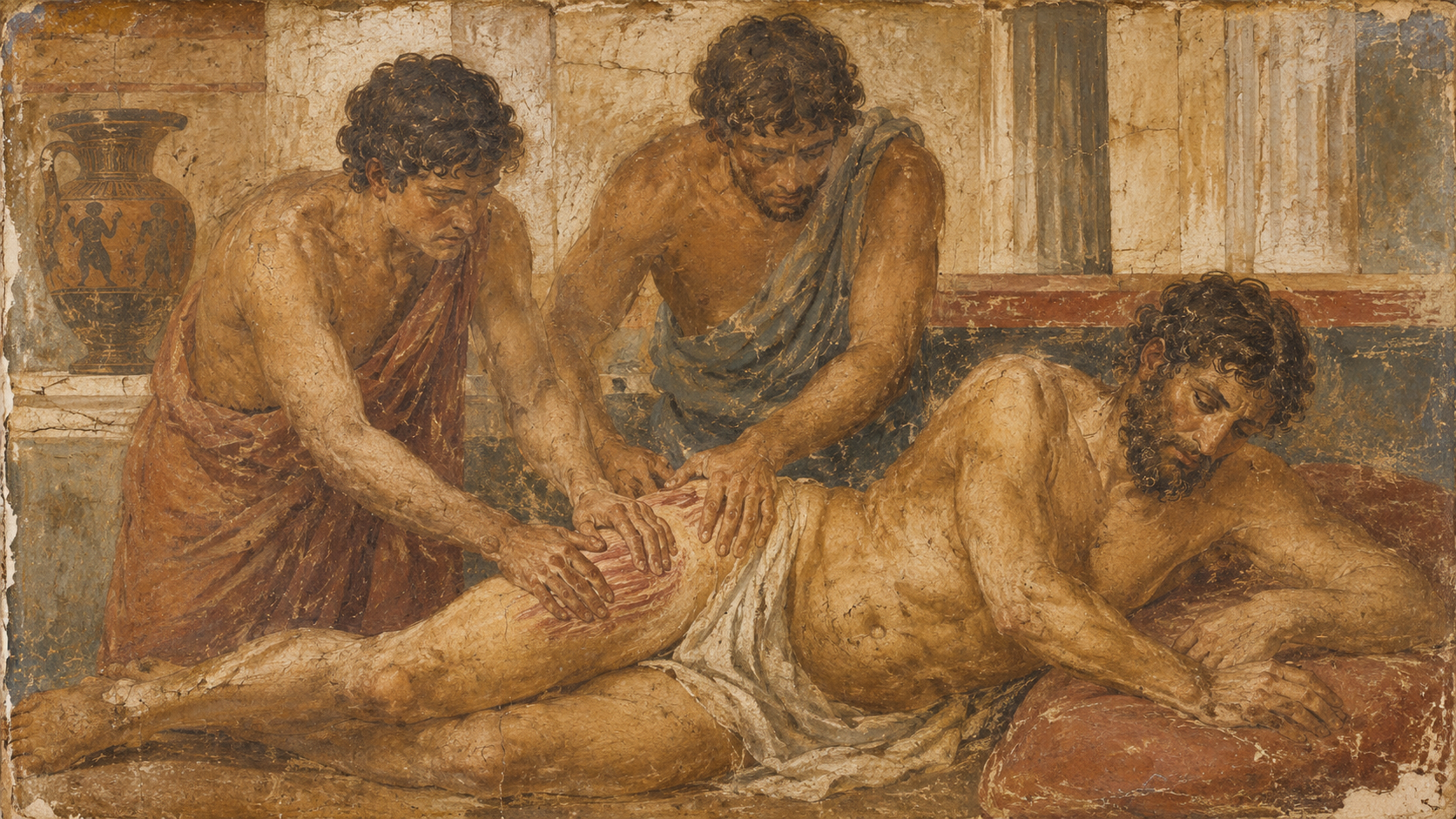
The first step of hip treatment has not changed since 460 BC. That was never the problem.

Warm it up first, then do the exercises.
If you have ever had treatment for hip pain, that was the order. Warm hands, or a heat pack, or twenty minutes of something hot on the outside of the hip. Then the strengthening.
I never questioned it either. Then a patient asked me straight out why we warm it up, and I gave her the honest answer, which is that people have been doing this for a very long time. Hippocrates wrote about heat for painful joints around 460 BC.
Two and a half thousand years, and it is still step one.
Now, that is not the scandal it sounds like, and I want to be fair about it. Settling a sore tendon before you work it is correct. It was correct then and it is correct now, and I do it with my own patients every week.
The problem is what happened to step two.
Because for most of the women I see, the warming is the only part that ever gets done properly. Week after week, year after year. The half that actually rebuilds anything gets a photocopied sheet, no numbers on it, and no instructions for the days it hurts.
So here is the whole thing, in the right order, including the part that never gets explained.
Nobody has told you what is actually wrong
Put your thumb on the outside of your hip and press until you find the bony point. That is the top of your thigh bone.
Two muscles from your backside attach to that point by way of tendons. Not the big one you sit on. The two hiding underneath it.
Those tendons have one job. When you stand on one leg, they hold your pelvis level so the other side does not drop. Which sounds like nothing, until you count how often you do it. Every step is a moment of standing on one leg. Every stair. Every time you get out of a car.
Now here is the part that changes everything, and almost nobody gets told it.
Most women with this are given a name for it that ends in itis. That means inflammation. It is a leftover from forty years ago, it is wrong, and it sends people in exactly the wrong direction.
The tendon is not inflamed. It is worn.
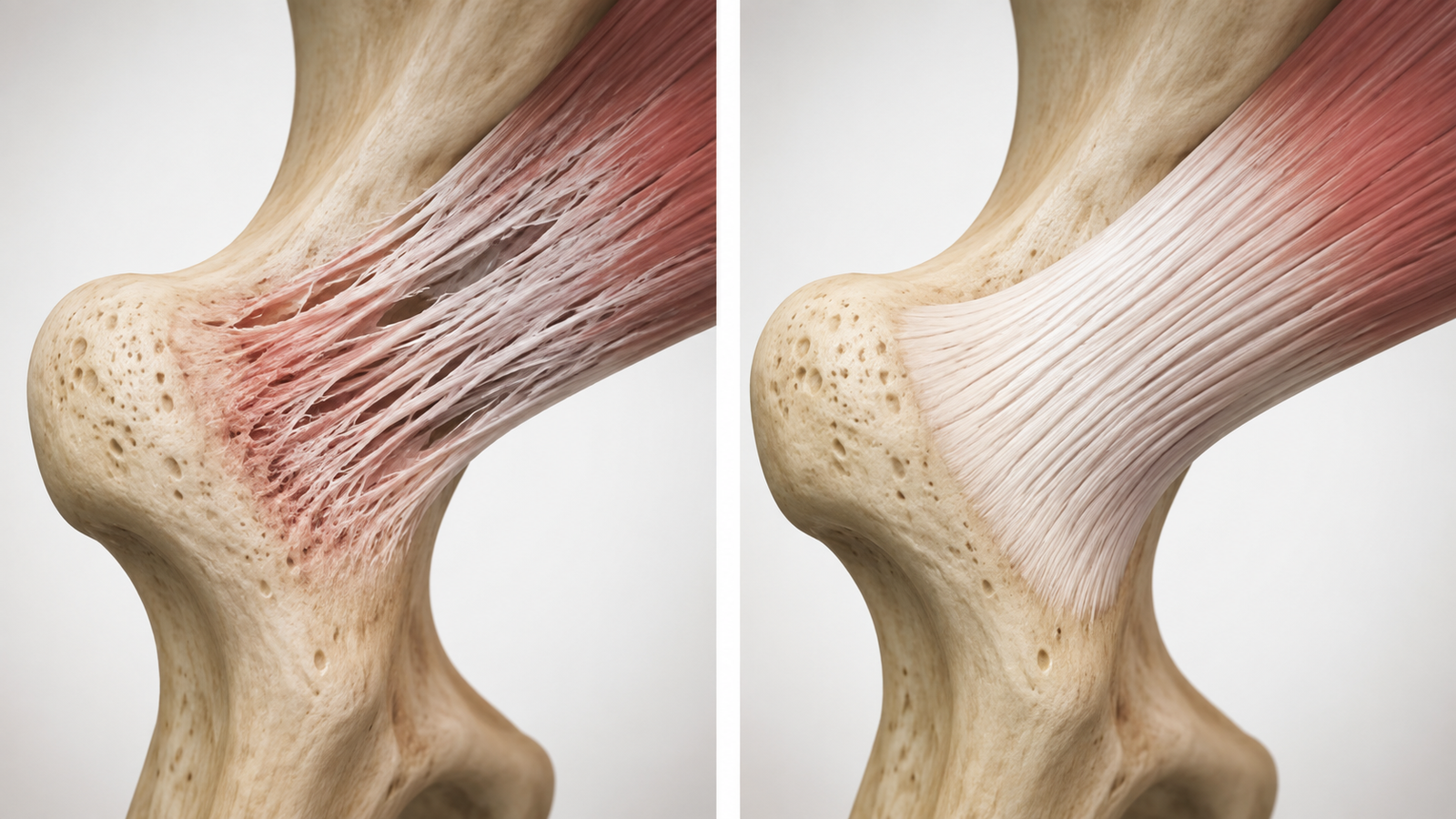
A healthy tendon is fibres packed tight and running the same way, like the strands of a rope laid properly. Under too much load, or a sudden jump in load, or years of steady load in a body that repairs a little slower than it used to, those fibres thin out and lose their order where they meet the bone.
Nothing tore. Nothing snapped.
The rope just holds less than it used to.
That one sentence explains almost everything that has happened, including the parts women blame themselves for.
Two things can happen to that tendon, and they are opposites
This is the most important thing on this page, and it is where nearly everyone goes wrong.
You can squash that tendon, or you can work it.
Squashing is when it gets pressed sideways into the bone underneath it. That happens whenever your thigh moves in toward the middle of your body. Crossing your legs does it. Standing with your weight dropped into one hip does it. Lying on that side presses it straight into the bone. So does a stretch that pulls your knee across your body. And so do some positions and not others, which is the part nobody says out loud in a clinic room.
Working is different. That is the tendon pulling along its own length while the muscle does its job. That is what it is for, and in the right amount it is the only thing that makes it stronger.
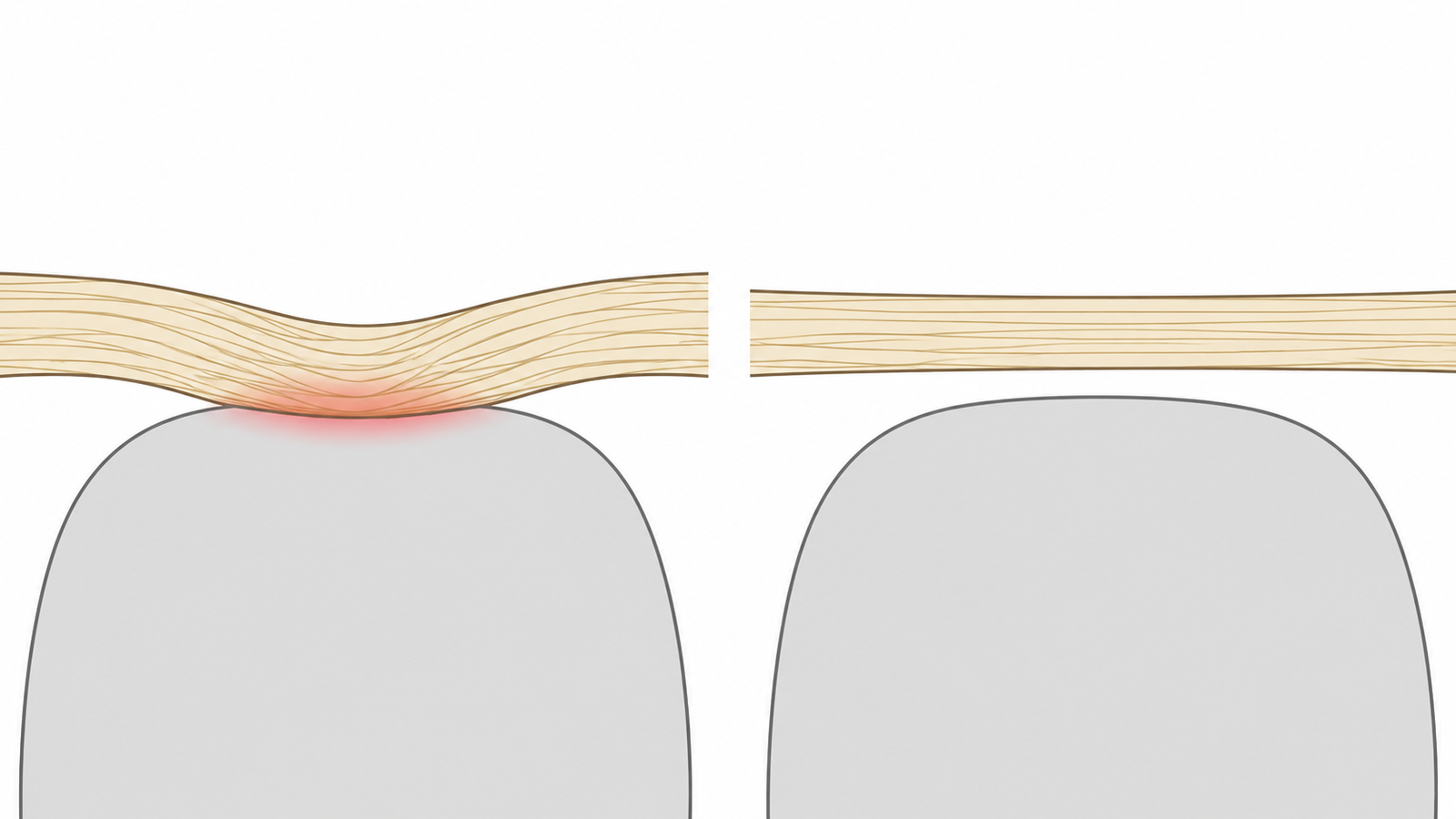
Same tendon, same hip. One of these irritates it and one of these rebuilds it.
Squashing irritates it and builds nothing. Working is the only thing that adds capacity back.
And because both of them feel like using your hip, almost nobody separates them. So women end up avoiding all of it, which removes the working and leaves the squashing exactly where it was.
It also explains why the pain is not random. Stairs hurt because a stair is standing on one leg. Getting out of a car is the same. So is the last twenty minutes at a kitchen counter, when you are tired and you have quietly started leaning into one hip.
Open the drawer
Everybody with this has a drawer, or a cupboard, or a corner of a bedroom. Here is what is usually in it, and what each one is actually doing.
The heat pad
The massage gun
The foam roller
The stretches
The cortisone shot
The red light device
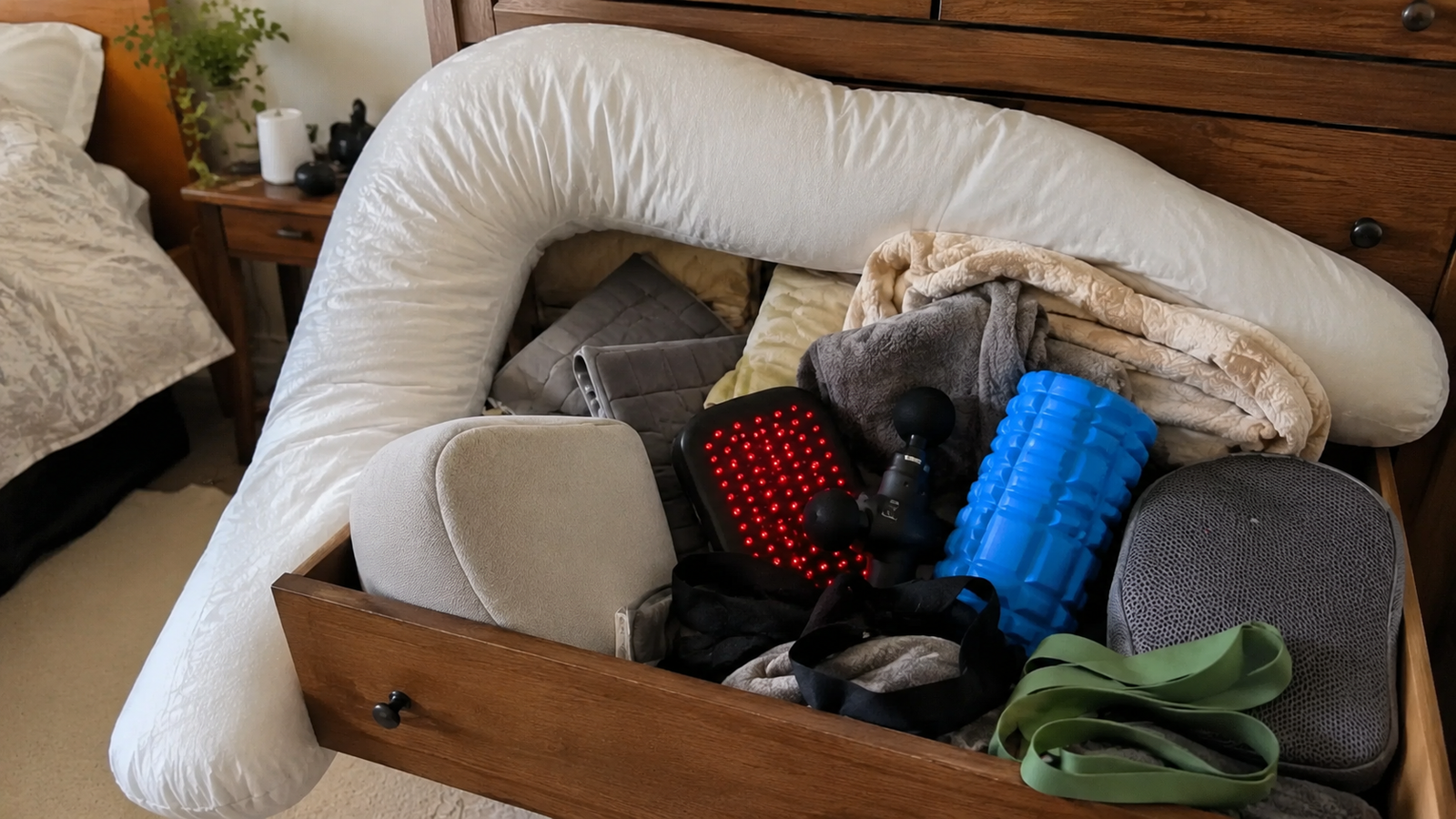
Now look at that list as one thing instead of six.
Every item on it either calms the tendon or does nothing at all. Not one of them makes it hold more than it did.
That is why the relief always runs out. The same half of the treatment, over and over, from different shops, at different prices.
It was never bad luck and it was never gullibility. It was a category that only does one job.
And then there is the thing you did for free that made it worse
This is the one people find hardest to hear, so I would rather you heard it from someone who does this for a living.
Resting it made it weaker.
Think about an arm coming out of a plaster cast after six weeks. It is visibly thinner than the other one. Nobody is surprised by that and nobody thinks the arm is damaged. It just stopped being asked to do anything.
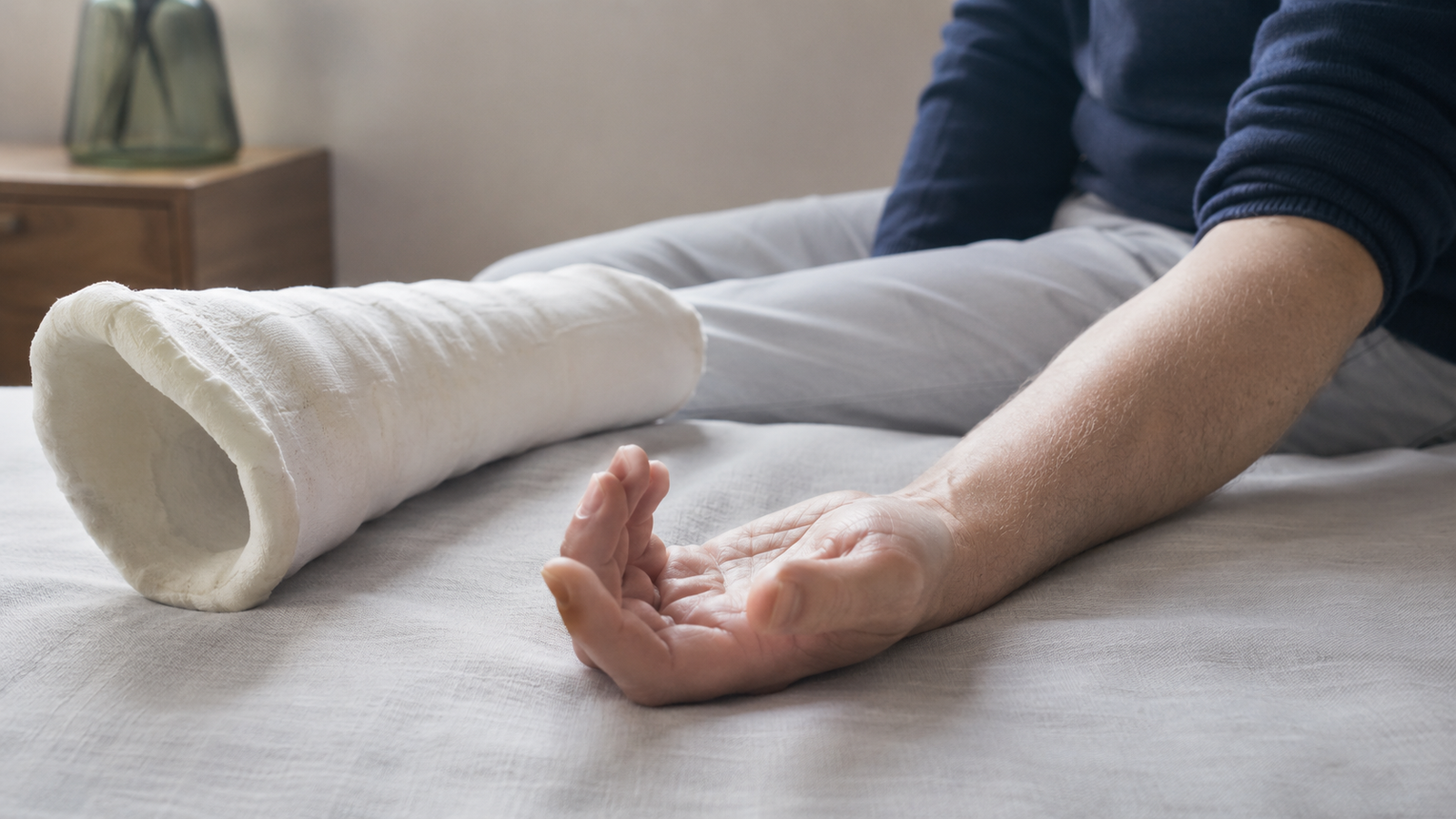
Tendon is living tissue and it behaves the same way. It holds what you ask it to hold. Ask it for less and it gives you less.
And here is where the last section pays off. Resting does not protect you from squashing. You can sit still all day with your legs crossed and squash it the whole time. What resting removes is the working, which was the only half building anything.
So every careful week counted against you. Not because sitting down is wrong, but because the tendon was getting less of the one thing it needed and just as much of the thing it did not.
Then something completely ordinary hurts more than it did last year, and it feels like the whole thing is getting worse.
It is not getting worse. It is getting weaker. Those are two different problems, and only one of them can be undone.
The part almost nobody gets given
There is a piece of this that is not the light and not the exercises. It gets skipped every time, and it probably costs more than either.
It is what you do with that hip on an ordinary Tuesday. Which chair you sit in. Whether you cross your legs at a desk. How you stand while the kettle boils. Which side you sleep on and what is between your knees when you do. Which positions squash it and which ones do not.
I see someone for one hour a week. They have the other hundred and sixty seven on their own, and that is where the progress quietly comes undone.
And the honest version of why is not that clinics do not know this. Every physiotherapist will tell you to watch how you sit and how you sleep. We say it. We say it at the end of the appointment, in about ninety seconds, while you are putting your coat on.
What almost nobody hands you is the detailed version. The one that covers your Tuesday, and the morning it is already sore, and the specific position you have slept in for thirty years. That takes twenty minutes to do properly, and I have twelve for the whole appointment.
So you get the headline and never the instructions.
I was told to be careful, and then sent home with no idea what careful meant.
What actually rebuilds a tendon
One thing does, and I am sorry to tell you it is the boring one.
You load it. Carefully, in an amount somebody tells you, most days, and you increase it as it adapts.
Tendon cells respond to being worked. Give them the right amount and they lay down new collagen along the lines of force. The rope gets denser and better organised and starts holding again.
That takes weeks, not days. Which is where most people stop, usually about a fortnight before anything would have shown up.
And the evidence for this is not thin.
In 2018 the BMJ published a trial of 204 people with this exact condition. It put a guided programme against a cortisone injection, and against waiting to see. At eight weeks the guided group was doing substantially better than either. At a year they were still ahead on how they rated their own condition, although pain intensity scores were similar across the groups by then.
Now look at what that winning group was actually called.
Education plus exercise.
Not exercise. The explaining was in there from the start. It is half the name of the thing that beat a steroid injection, and it is the half that disappears the moment a programme becomes a photocopied sheet.
That trial tested physiotherapy delivered by clinicians across fourteen sessions in eight weeks. It did not test any device, including the one described further down this page. What it established is the principle: guided, progressive loading is what rebuilds a worn tendon.
There is one more number in there worth sitting with.
Fourteen sessions in eight weeks. That is what the research used. Almost nobody gets that. Cover runs out, appointments get spread thinner, and people end up doing a fraction of the dose the evidence was built on, then concluding it did not work for them.
The treatment was never wrong. Most people just get far too little of it.
What I point people to
There is one thing I have found that does all three in the same box, which is the only reason it is on this page. It is called the ARESS Springline System.

1A wrap
2Two resistance bands
3A guided programme
4The handbook
Three Months
I cannot guarantee you anything, and I would not trust anyone who says they can. All I can do is tell you what these three months were for me.
Twenty minutes of light with my coffee, then the day's exercises off the phone.
The first month, I walked. Around the block at first, then further, then the first mile of my old route with my husband beside me.
The second month my shoes came out of the closet and back to their spot by the front door. Neither of us said a word about it, and he smiled all through breakfast.
This month, for the first time in two years, I jogged. Lightly, carefully, a few soft stretches of it on the flat part of my street. I know better than to rush now.
But I wake up at six excited again, and I cannot wait to see where another month takes me.
Last Sunday we walked to the corner where my hip once stopped me under the streetlight, and I stood there and cried.
This time it was the good kind.

If any of this sounded familiar
I cannot tell you what your hip will do, because I have never seen it, and you should not trust anyone who says otherwise.
What I can tell you is that the two halves are not a marketing idea. They are how the tissue behaves, and almost everything sold for this does one of them.
There are ninety days on it. Not thirty, because thirty tells you nothing about a tendon.
90-day money-back guarantee · Guided programme included · Ships in 7–10 business days
One last thing about the warm-up, because I think people carry a lot of guilt about this.
It was never wrong. It was never a waste. Settling a tendon so the work becomes possible is a real job and it is the reason the loading is bearable at all.
It just was never the half that changes anything, and almost nobody is told that. So women do step one faithfully for two years, go backwards anyway, and conclude they did not try hard enough.
They tried plenty. They were handed the oldest part of the treatment and told it was the treatment.
ARESS Springline guides general conditioning for hip comfort and mobility. It does not diagnose or treat any condition and is not a substitute for advice from a qualified clinician who has assessed you. If you have pain radiating below the knee, numbness or pins and needles, pain that began after a fall, or hip surgery in the last six months, speak to a clinician before starting any loading programme.