
How a worn tendon rebuilds.
What lateral hip pain actually is, what the research shows about repairing it, and how Springline is built around that.
It sits outside the joint.
Pain on the outer hip, worse lying on that side and worse on stairs, usually has one source: the gluteal tendons where they anchor into the greater trochanter, the bony point on the side of the upper thigh.1
This is gluteal tendinopathy. The tendon fibres at the attachment become disorganised and lose capacity, so ordinary loads start to hurt.
It explains a detail many people find confusing. Imaging of the hip joint often comes back clear, because the joint is not the problem. The tendon sits outside it.

Tendons rebuild by being loaded.
This is the part that is genuinely counter-intuitive, and it is the principle the whole programme is built on. Tendon is living tissue that adapts to the demands placed on it. Take the demand away and capacity falls further.1,5
Load is a signal
Cells inside a tendon sense mechanical strain and respond by producing new collagen. No strain, no signal.
Rest lowers capacity
Protecting a sore tendon feels sensible and reduces its tolerance further, so the same activity hurts more later.
Slow and heavy works
Controlled resistance held under tension produces the adaptation. Fast or bouncy movement does not, and irritates it.
Progression is the point
The load has to keep rising as the tendon adapts. A resistance that stays the same stops producing change.
Three parts, three jobs.
Tap a plus to see what each one is for.

The light wrap
Red and near-infrared LEDs in a cordless band shaped to sit over the outer hip. It warms and settles the area so that the loading which follows is comfortable enough to actually complete. Worn through the whole session.
Tap to expand

Graded bands
Two tensions, used in sequence across the twelve weeks. The lighter band builds tolerance, the firmer one keeps raising the demand once the tendon has adapted. Progression is what produces the change, so the resistance has to move.
Tap to expand
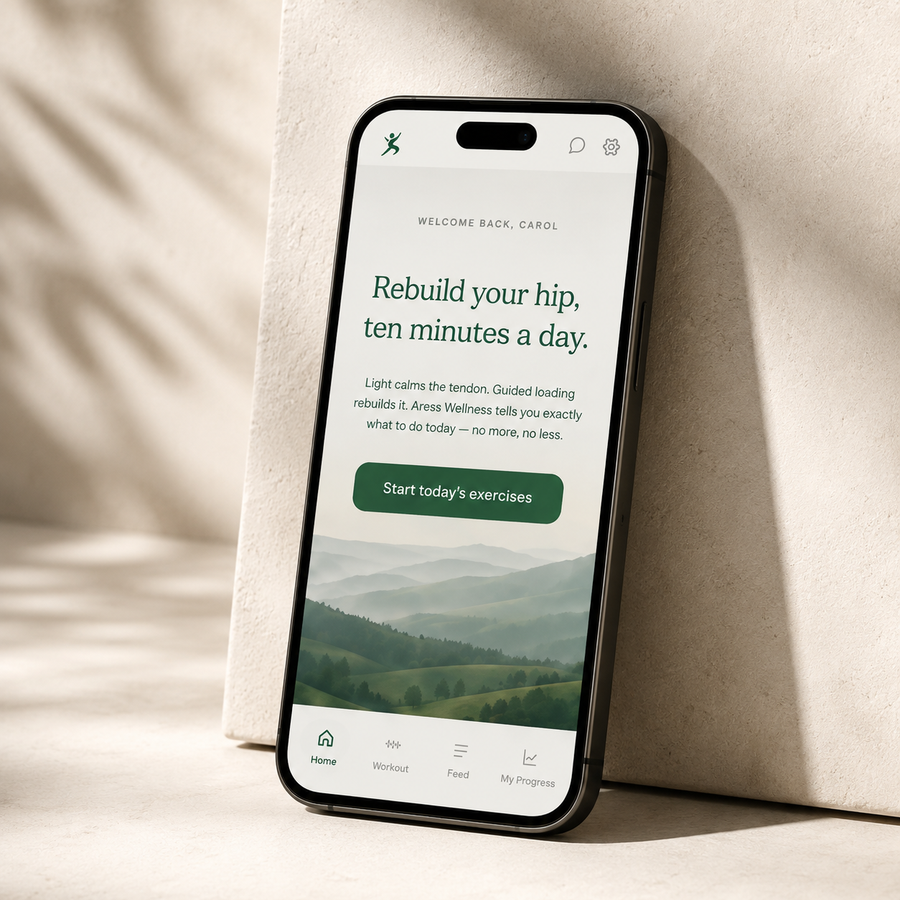
The guided app
It sets the dose for each session, shows every movement, and defines the point to stop. In the analysis that followed the main trial, a person’s confidence in managing their own hip explained more of the improvement than strength gains alone did.4
Tap to expand
What the largest trial found.
In 2018 the BMJ published a randomised trial of 204 people with gluteal tendinopathy, assigned to a guided education and exercise programme, a corticosteroid injection, or a wait-and-see approach.3
The chart shows the proportion in each group who rated themselves much or moderately better at 52 weeks. At the earlier eight-week point the injection group had done well; by one year the exercise group was the only one still ahead.
This is the principle Springline is built on: progressive loading, guided and dosed, over a period of months.
Rated much or moderately better at 52 weeks. Mellor et al., BMJ 2018.
This trial tested a physiotherapy programme delivered by clinicians. It did not test Springline or any device. Pain intensity scores were statistically similar across groups at one year.
Compression is what these tendons tolerate least.
The tendons run over the bony point of the hip, and anything that draws the thigh toward the midline presses them against it.1 Compression combined with stretch is the load a tendon handles worst.
That single fact shapes the whole programme. It determines which movements are in it, which are deliberately left out, and which everyday positions the app asks you to change first.

Why the light comes first.
Red and near-infrared light is not heat. It is absorbed by tissue and studied for its effect on local pain and comfort, a field known as photobiomodulation. A systematic review across tendon problems found a real short-term effect on pain and function when the dose was right.6
That is exactly the job it does here. The light calms. The loading rebuilds. Comfort is not a side benefit, it is what makes the work possible on a morning when the hip is sore, and finishing the work is what produces the result.
The specific evidence base for light in gluteal tendinopathy has not yet been established, which is precisely why we pair it with the loading programme rather than selling it on its own.
The numbers, published.
Most wraps don’t print these. We do, because you should be able to check before you buy.
Get startedTwelve weeks, honestly mapped.
Tendon adaptation is slow enough that you cannot feel it day to day. Knowing the shape of it is what stops people stopping in week three.
Calm and activate. Isometric holds at low load, and changing the daily positions that keep the tendon compressed.
Loading begins in earnest. This is the window where the trial groups separated, and where stairs typically start to feel different.
Heavier, slower, single leg. Building the capacity that has to hold up to ordinary life rather than to a gym.
Clinical sources place meaningful recovery in this condition at three to six months.1 Twelve guided weeks is a substantial part of that.
Both halves, twenty minutes a day.
The wrap, the bands, and an app that doses every session. Ninety days to decide.
Springline guides general conditioning for hip comfort and mobility. It does not diagnose or treat any condition and is not a substitute for advice from a qualified clinician. If you have pain radiating below the knee, numbness or pins and needles, pain that began after a fall, night pain that repeatedly wakes you, or hip surgery in the last six months, speak to a clinician before starting any loading programme.