
5 Things That Have Drastically Decreased My Patients' Hip Pain In A Matter Of Weeks.


I see this every week.
A woman in her 50's. Two years of hip pain, and a folder full of things that did not work.
She was told it was bursitis. Then sciatica. Then it was her back. Then her age.
She took two cortisone shots just to relieve some pain and three rounds of physio that cost her an arm and a leg. She even tried every stretch on YouTube without knowing it just made her condition worse.
And after all that, she still cannot sleep on her side.
She is beyond confused. She trusts no one, especially not her own doctor. How could she? All she got was two years of misdiagnosis and over a thousand dollars spent on treatments that were never going to work.
I see this same exact story every week, and I am tired of giving the same advice one email at a time. So here it is, once and for all. The 5 things I tell every patient.
Put a pillow between your knees tonight
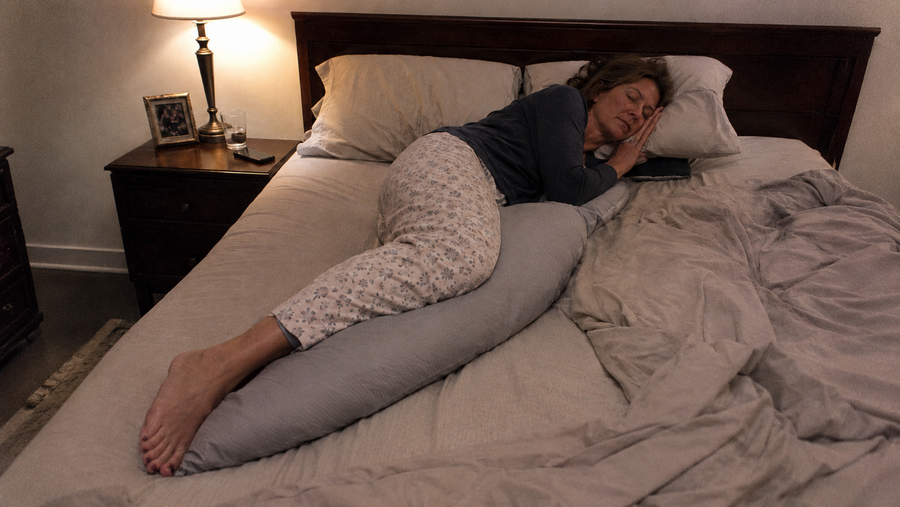
Start here. It costs nothing and it works tonight.
You spend eight hours a night in one position. That is the longest single thing you do to your hip all day, and most women spend it compressing the exact tissue that hurts.
The fix is a pillow, and one detail almost nobody tells you: it has to run from your knees down past your ankles. A short pillow supports the knee and lets the foot drop, which recreates the exact angle you were trying to avoid. A long pillow keeps the whole leg level and puts your hip back in line.
Most of my patients notice a difference in how they sleep within the first week. That is not the tendon healing yet. That is you stopping the thing that kept it irritated.
You do not need to buy anything special for this. A long body pillow works. So does a folded duvet. What matters is the length, not the product.
Know what not to do during the day
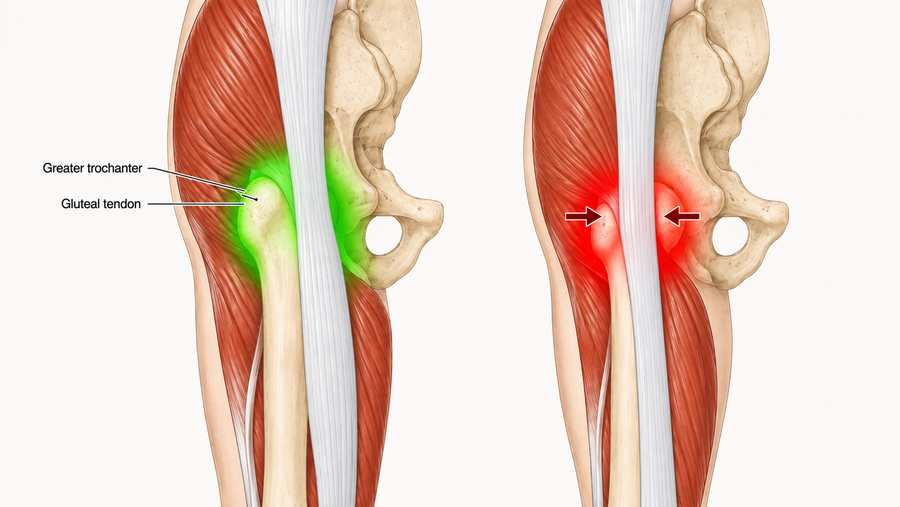
You can do everything right for months and undo all of it in a couple days.
These are the ones I take patients off first...
Stretching. The IT band lean, figure-four, pigeon, anything that pulls your knee across your body. The tendons run over a bony point, and every one of those movements presses them harder into it. Compressive force across the hip rises sharply the further the knee crosses the midline. It feels like a release but it is the opposite.
Foam rolling or using a massage gun. Stretch and direct pressure at the same time, straight onto the tissue that is already irritated.
Clamshells. They are on nearly every hip sheet ever handed out, and are the single worst exercise to do. Side-lying already brings the leg toward the midline, and the movement swings the hip in and out of it. A hundred reps of compression, very little load.
Sitting with your legs crossed, and standing hip-out. You hold these for hours a day, which makes them more important than anything you could do in a session.
Complete rest. The most reasonable-sounding one on the list. A tendon that is never loaded becomes weak, so the flare comes back sooner each time.
Load the tendon, because nothing else rebuilds it
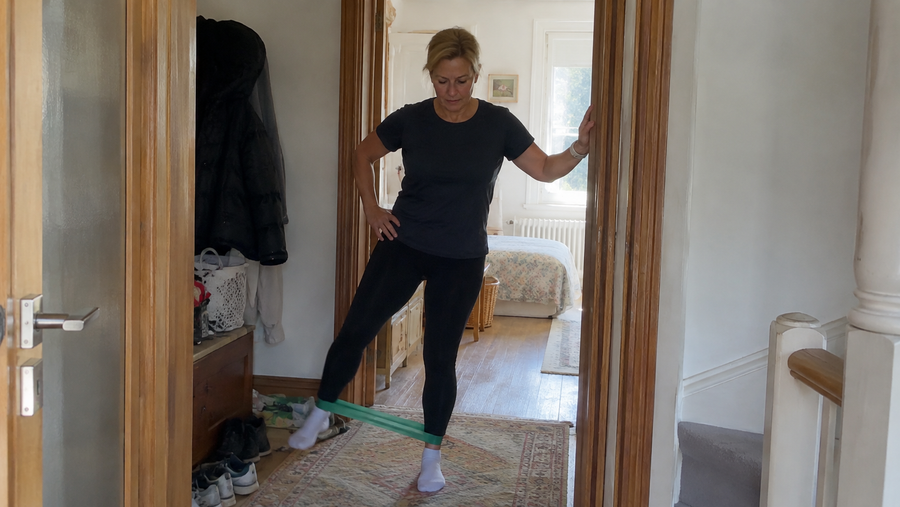
This is the one that changes the tissue, and it is the one almost nobody completes.
Everything else you have been offered was built for relief. The shot, the anti-inflammatories, the heat, the massage gun. They all quieten the signal. Not one of them asks the tendon to do anything, which means not one of them makes it stronger. A tendon that is never asked to hold anything does not get better at holding things.
Progressive loading is the only approach in this condition with a large trial behind it. Education about load plus a structured exercise programme beat a corticosteroid injection at eight weeks, and was still ahead a year later.
And it is not the exercises you have seen. Clamshells were deliberately left out of those trial programmes, because they take the hip into the position that compresses the tendon while barely loading the muscles you are trying to build. The right work is specific, it is banded, and it climbs in steps small enough that the tendon can absorb them.
Calm it before you load it, not after
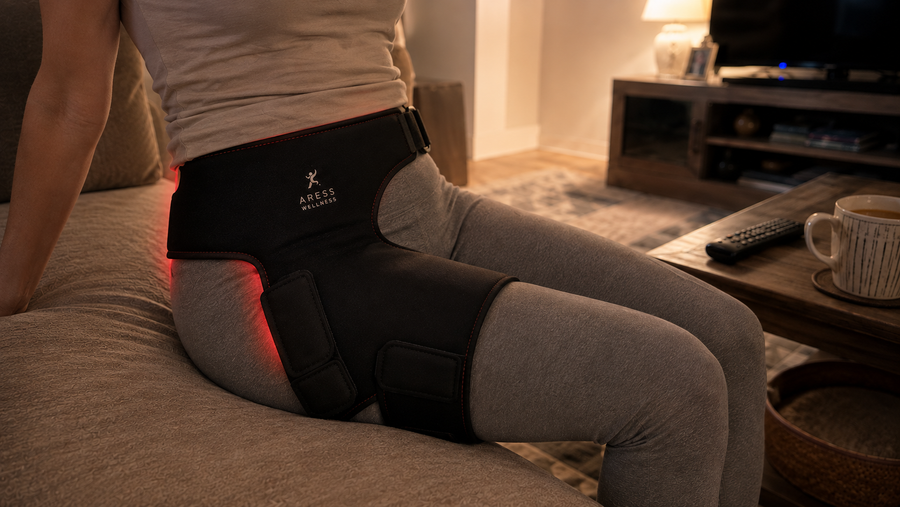
This is where most women fall out of the programme, and it happens in the first fortnight.
They start the exercises with a hip that is already irritable. Every session hurts. The next morning is worse. Within two weeks they have decided the loading is the problem, and they stop.
The loading was never the problem. The order was.
A red and near-infrared light wrap over the outside of the hip settles the area before you work. It is not heat and it is not a painkiller. It takes the edge off enough that the session becomes something you can actually do, then repeat tomorrow, then repeat for three months.
I will be straight with you about what each half does, because you deserve that. The light is what makes the work survivable. The loading is what rebuilds the tendon. You need both, in that order, and a programme you finish beats a better one you abandon in week three.
Adjust every session to your pain level
This is the complaint I hear most often.
Patients are using the wrap. They are doing the exercises. Six weeks in, and it still hurts. So they email me convinced the programme has failed them.
It has not. They are doing the same session every day regardless of what their hip is telling them.
Some days that is too much and they flare. Other days it is too little and nothing changes. Across six weeks the two cancel each other out, and they end up where they started, doing the work and getting nowhere.
Here is why the timing catches people out. A tendon does not tell you the truth in the moment. Something that overloads it usually feels fine while you are doing it and only shows up eight or ten hours later. The thing that set you back happened yesterday, which is why so few people ever make the connection.
So stop judging by how the session felt. Judge by the following morning.
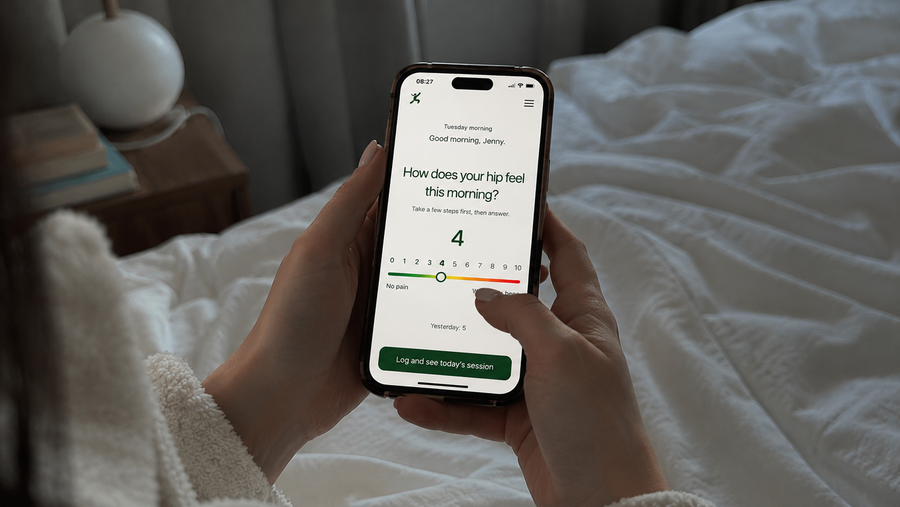
Take your first few steps and score the hip out of ten. The same as yesterday or better means the dose was right and you can hold or progress. Clearly worse than your normal baseline means you did too much, and today should be lighter. Lighter, not skipped.
And here is the part that is genuinely difficult to do unaided. Scoring your hip is straightforward. Interpreting the score is not. A six in week two and a six in week nine call for entirely different responses. That is the calculation the app runs on your behalf. You log the number, and it sets the session.
If you only remember one thing...
Calm it. Load it. Measure it. In that order.
That is the whole sequence, and every one of the five tips does one of those three jobs.
Tips 1 and 4 calm it. The pillow stops eight hours of compression every night. The wrap settles the tendon before you ask anything of it.
Tip 3 rebuilds it. Progressive loading is the only thing on this list that changes the tissue. Everything else was built for relief.
Tips 2 and 5 measure it. Knowing what makes it worse, and knowing how much is too much today. Without those two, the loading either does nothing or sets you back.
Every treatment you have been offered does one of these three jobs. Not one of them hands you all three, in order.
The system that takes care of everything
When patients ask me what to buy, I point them at one thing, because it is the only box I have seen that holds the whole sequence rather than one slice of it.
The ARESS Springline System pairs a red and near-infrared light wrap with the graded bands, the handbook, and an app that does the morning maths for you. You wrap the hip, the light settles it, and the app tells you exactly what today's session is based on the number you just logged.
That last part is what makes it finishable. You are never guessing what comes next, and you are never grinding through the same week one for two months because nobody told you when to progress.
What comes in the box
Complete the 3 months or your money back
What people are saying

Finally sleeping on my side again.
For three years I was a forced back-sleeper. Rebuilding my glute tendons let me sleep on that hip again.
I can cross my legs at my desk.
A small comfort I had lost for two years. So happy to have it back.
I don't dread long car rides.
Sitting for more than an hour used to mean I'd be limping at the rest stop. Now I can drive for four hours without stiffening up.
Sat through a whole movie.
Those plush theatre seats used to be a torture device for my outer hips. Saw a three-hour film this weekend in total comfort.
No more wincing when putting on shoes.
Balancing on one foot to tie my sneakers was a daily nightmare. My single-leg balance is pain-free now.
Finally out of my recliner.
For eight months the only place I could sit was a fully reclined La-Z-Boy. I can use normal dining chairs again.
I finally stopped foam rolling my IT band.
The app taught me that rolling an irritated area makes it worse. Strengthening the glute medius was the actual fix.
The daily reminders are a lifesaver.
With my ADHD, if it's out of sight it's out of mind. The gentle push notifications mean I never miss a day.
It works even if you're out of shape.
I hadn't worked out in five years, but Phase 1 is gentle enough that anyone can start without fear.
Works for men too.
You usually hear about this in women, but as a 60-year-old man my tendinopathy was severe. This system doesn't discriminate.
Where this goes from here
Another year of the same
- Another shot when it flares badly enough
- Stretching that feels good and sets you back by morning
- Resting it, and losing a little more capacity each month
- Still dreading the stairs and the long drive
- Still sleeping on your back because there is no other option
Three months from now
- Twenty minutes a day at home, no appointments
- Settle it, then rebuild it, in the right order
- An app that tells you what today looks like
- The positions fixed, so the nights stop undoing the days
- Complete the three months or get your money back
What patients ask me
How long before I notice anything?
The nights are usually first, often inside the first two weeks, because that is the fastest thing to change. Real capacity takes longer. Judge it in months, not days, and use the morning score to see the trend.
Is this instead of physiotherapy?
No. If you can see a physiotherapist, see one. This exists because a full course is fourteen sessions and most people are offered five, then left to work out the rest alone.
I have already had injections. Does that rule me out?
Not at all. Most of the women I see have had at least one. An injection opens a window where loading becomes possible. Nobody ever gave them anything to put in that window.
What if the exercises hurt?
Some discomfort during a session is expected and fine. What matters is the next morning. That is the whole of tip five, and the app is built around it.
How do I know this is my problem?
Pain on the outside of the hip, worse lying on that side, worse crossing your legs, worse on the first steps out of bed. If your pain is mainly in the groin, or travels below the knee, or started after a fall, see someone before you begin anything.
The last thing I tell people
You did not fail at this.
You stretched because you were told to stretch. You rested because it seemed obvious. You had the injection because someone you trusted offered it. Every one of those was a reasonable thing to do, and not one of them was aimed at the tissue that is actually worn.
Give it three months with the right sequence and most people in your position get their life back. Not a slightly better version of managing it. Sleeping on that side. Taking the stairs without thinking about it first. Walking for hours because you want to.
That is what this is for.
The ARESS Springline System
$99.99
Get Started Now✅ Complete the 3 months or your money back · App and handbook included · No subscription